
Ready-to-Use Segments
Global POIs
Partners
What Is Location-Based Targeting?
Location based targeting helps advertisers reach relevant audiences using place based signals tied to consumer movement and visitation patterns. Compared with broader demographic or online interest based approaches, it can help marketers align ad campaigns to real world context and improve relevance across the purchase journey.
For marketers, this distinction matters because it swaps inferred interest for verified action. An online interest segment like ‘food enthusiast’ is often just a guess based on search history; however, someone who physically visits a fast-casual restaurant multiple times a week provides a hard signal of purchase intent. Similarly, while a keyword search suggests someone is merely considering a product, seeing them at a competitor’s retail location identifies a high-intent shopper at a completely different state of receptivity, actively moving through the decision-making process in real time. Location data makes these moments actionable and measurable.
There are two primary forms of location-based targeting:
Audience Targeting — Behavioral, Historical
Location-based audiences allow marketers to reach consumers based on past visit patterns, purchase behaviors, and demographic data. Connect with consumers who have demonstrated relevant intent over time or recently, regardless of where they are right now.
Proximity Targeting — Real-Time, Location-Based
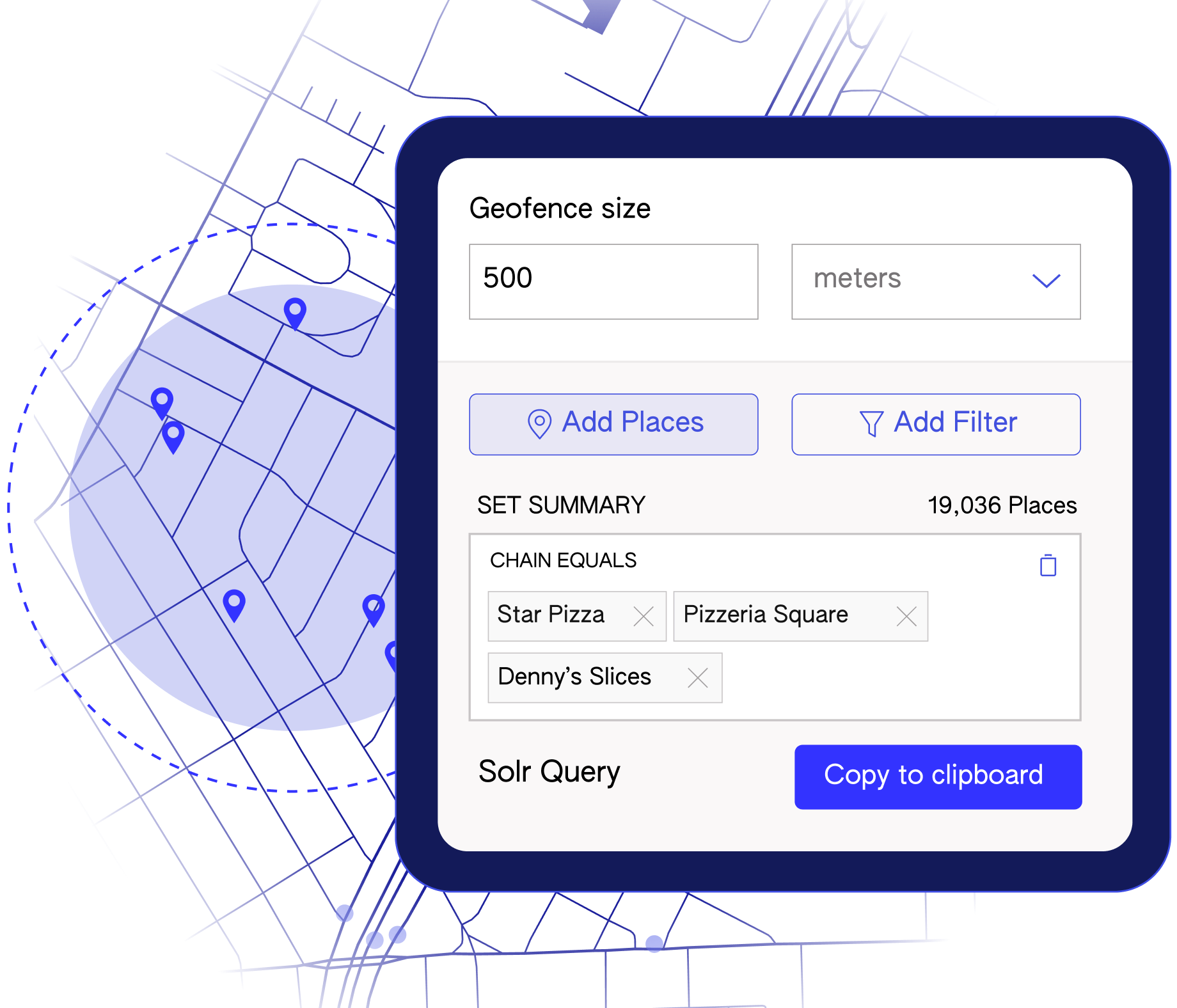
Location-based proximity segments enable ads to be triggered in real time based on when users enter a defined geographic boundary (geofence). This allows advertisers to meet consumers in the moment of maximum relevance, like when they are physically near a store, event, or competitor location.
By shifting the focus from broad demographics or online clicks to verified real-world actions, location targeting enables a new level of campaign personalization. Advertisers can move beyond generic messaging to craft campaigns that speak directly to a consumer’s demonstrated behavior. For example, serving a coupon for a nearby coffee shop to a morning commuter, or an ad for a new running shoe to someone recently identified as a “Routine Gym-Goer”. This ability to align the message, offer, and context with the consumer’s lifestyle and immediate environment dramatically increases ad relevance and response rates.
While these strategies are highly effective when used independently, they are even more effective when deployed alongside one another to provide a holistic, full-funnel approach within a single campaign. A QSR brand might build a Foursquare Audience segment of frequent fast-food visitors for awareness campaigns running across CTV and social, while simultaneously running Foursquare Proximity geofences around their top 500 locations to capture intent at the moment of decision. By executing these distinct tactics together, marketers can address the entire journey, from consideration to conversion.
According to research cited by Foursquare, 90% of marketers saw higher sales and 84% reported increased engagement when using location-based advertising. Forrester research found that Foursquare’s targeting solutions deliver 4x greater scale and over 200% ROI.
How Audience Targeting Works
Foursquare Audience helps marketers build customizable audience segments using location and visitation signals. The Targeting Designer is built for marketers — from brand teams to agency trading desks — who need to reach specific consumer profiles with precision at scale across over 550+ partners and channels, including digital, social, Linear TV, CTV, audio, and OOH.
The Data Foundation
Foursquare Audience is powered by our proprietary Places and Movements datasets. This foundation supports audience creation based on brand affinity, category activity, and visitation trends.
- Places— Foursquare’s POI dataset covering 100M+ global points of interest. It includes chains, categories, attributes, and sub-venue geometry that allows accurate identification of where a consumer visit occurred, including within multi-level buildings and dense urban centers.
- Movements— Foursquare’s proprietary visit detection layer, built on Stop Detection algorithms and Snap-to-Place technology. This converts signals from devices into clean, accurate visit records, filtering out drive-bys, GPS drift, and non-visit dwell signals that would otherwise corrupt behavioral segments.
Segment Types
Marketers can build audience segments across various dimensions:
| Segment Dimension | Examples |
|---|---|
| In-Market / Intent-Based / Lifestyle / Behavioral | High-Frequency QSR Visitors, Routine Gym-Goers, Recent Car Dealership Visitors, Avid Travelers |
| Competitive / Conquesting | Competitor Restaurant Visitors, Visitors to Rival Retail Chains, Brand Switchers |
| Demographic + Geographic | High-Income Households in Urban ZIP Codes, Suburban Parents, College Students who Live Near Target |
| Purchase-Based / Transactions | Streaming Subscribers, Rideshare Customers, Luxury Fashion Accessories, Airline Customers |
| Seasonal | Holiday Shoppers, Summer Vacation Planners, Back-to-School Buyers, Black Friday Shoppers |
| Lifecycle & Retention Stage | Lapsed Customers, Loyal Repeat Visitors, First-Time Visitors to a Category or Chain |
The Self-Serve Targeting Designer
Marketers, planners, and programmatic teams have two ways to get these segments live. For those who want full autonomy, Foursquare’s self-serve Targeting Designer gives them direct access to build their own audiences, check estimated scale, and push segments to their DSP seat exactly when they want.
For teams looking for more strategic collaboration, Foursquare also offers managed service support. In this model, Foursquare’s internal experts act as an extension of the team to consult on strategy, complex builds, and help fine-tune targeting for the best possible results.
Teams can instantly activate 2,300+ pre-built location segments and 800+ purchase-based audiences available off-the-shelf across major ad platforms. For more custom needs, the Targeting Designer allows planners to build bespoke behavioral segments from scratch—defining their own visitation windows, frequency thresholds, and geographic filters to match exact campaign requirements.
Audience segments can be deployed to over 550+ partner channels, including Demand-Side Platforms (DSPs), data onboarding and identity platforms, and omnichannel media platforms, including The Trade Desk, LiveRamp, Yahoo, and Google DV360. All major channels are supported: digital display, social, CTV, OOH, and streaming audio.
Dynamic Segment Refresh
A key advantage of location-derived segments over static third-party data is behavioral recency. As consumer habits shift—a gym-goer lapses, a coffee shop loyalist stops visiting, or a retail customer begins visiting a competitor—Foursquare’s taxonomy of pre-built segments update on a set refresh cadence to reflect real-world change. This ensures marketers are reaching consumers based on recent behavior, not outdated signals or preferences.
While these pre-built standard segments update automatically, custom segments can be refreshed on a tailored cadence to meet specific platform and campaign needs. Teams can work with Foursquare to set a refresh schedule that aligns with their strategy, ensuring that their targeting stays aligned with evolving consumer behavior throughout the flight of a long-term campaign.
Audience segment refresh is particularly valuable for lifecycle targeting: winning back a lapsed customer requires an audience whose status is current and verified, not inferred from stale data.
How Proximity Targeting & Geofencing Works
While Audience targeting reaches consumers based on where they have been, Proximity targeting reaches consumers based on where they are right now. Foursquare Proximity is the platform’s real-time geofencing solution, allowing advertisers to deliver ads to consumers at the exact moment they enter a defined geographic boundary.
What Is a Geofence?
A geofence is a virtual boundary drawn around a specific real-world location or point-of-interest (POI). When a consumer’s device enters that boundary, it triggers a real-time bid request within the advertiser’s DSP. If the advertiser wins the auction, the impression is delivered instantly, allowing them to reach the consumer at the exact point of decision, whether they are approaching a storefront, attending a major event, or visiting a competitor’s location.
Foursquare Proximity supports two primary geofence shapes:
- Point-radius geofences — A circular boundary defined by a center coordinate and a radius (e.g., reach consumers within 2 miles of each restaurant location or within 50 meters of a competitor location).
- Polygon geofences — Custom shapes that precisely trace the boundary of a specific place — a mall, a stadium footprint, a trade show convention center. Polygon geofences typically reduce false positives from consumers who are near but not at the target location.
How Foursquare Proximity Works (Step by Step)
- Geofence Design —The marketer or planner uses Foursquare’s Proximity Designer to curate their target footprint with precision. You can select locations by broad category (e.g., all QSRs within a specific DMA), specific brand chains, or even individual points of interest (POI). For more bespoke strategies, teams can upload their own custom coordinates or use filters for locality, urban density, and category to refine their reach. For managed service clients, Foursquare does this step for you.
- Segment Generation — Foursquare converts the geofence design into a targetable segment, representing the virtual boundaries as lat/long coordinate arrays deployable to any programmatic, integrated DSP.
- Real-Time Impression Matching — At bid time, the ad platform validates whether the incoming impression’s lat/long coordinates fall within the geofence boundary. If they do, the bid is eligible, and if won, the ad is served.
A Note on Privacy-Forward Activation
Proximity is a privacy-forward solution that enables marketers to reach consumers without personal data sharing. Proximity segments do not require the pre-sharing of unique device IDs as the targeting happens at the impression level based on the real-time location of the bid request. Marketers will begin to see delivery metrics within their ad platform once the campaign begins to scale and impressions are won.
Audience vs. Proximity Targeting: When to Use Each
The most common mistake in location-based advertising is treating Audience and Proximity as interchangeable. While both are versatile enough to be leveraged across the entire consumer lifecycle, from initial awareness to post-purchase loyalty, each is typically best suited to a specific phase of the journey:
Audience Targeting — Behavioral, Historical
Ideal for upper- and mid-funnel strategies. This tactic focuses on the “who,” reaching consumers based on long-term lifestyle habits and brand loyalties to build sustained awareness and consideration.
Proximity Targeting — Real-Time, Location-Based
Primarily used for lower-funnel intent and conversion. This tactic focuses on the “where,” enabling real-time activation by engaging consumers based on their immediate surroundings to capture intent at the exact point of decision.
The table below clarifies the key decision factors:
| Dimension | Audience Targeting | Proximity Targeting |
|---|---|---|
| Signal Type | Historical behavioral visits | Real-time location |
| Targeting Basis | Aligning offers with a consumer’s demonstrated interests | Surfacing messages in the moment based on current location context |
| Time Horizon | Lookback window (e.g., visited in past 30/60/90 days or specific timeframes) | Real-time impression — in the moment |
| Best For | Upper/mid funnel; awareness, consideration | Lower funnel; in-store traffic, competitive conquesting |
| Privacy Approach | Built on privacy-by design principles | Impression-level geo match, no personal data sharing required |
| Channel Breadth | All channels: digital, social, Linear TV, CTV, OOH, audio, etc. | Programmatic; primarily mobile |
| Ideal Combination | Run Audience for reach + frequency; Proximity for influencing lower funnel behavior | |
When to use both together:
Foursquare recommends running Audience and Proximity as distinct, separate tactics within the same campaign rather than layering them together, which can overly restrict scale.
A retail brand might use Audience to reach in-market category buyers across CTV and social to build a foundation of awareness and consideration. They can then deploy Proximity as a separate line item to geofence store locations, capturing consumers who are now physically near a purchase point. This multi-tactic, full-funnel approach consistently outperforms single-tactic campaigns on both reach and conversion efficiency.
Geo-Conquesting: Using Location to Win Market Share
Geo-conquesting is the practice of placing a geofence around a competitor’s location and serving ads to consumers who are physically at, or near, that competitor’s store, dealership, restaurant, venue, etc. It is one of the most powerful applications of Proximity targeting, turning a competitor’s foot traffic into your own acquisition funnel.
Advertisers can also build audience segments based on prior visitation patterns to competitive commercial locations. These approaches can help advertisers tailor messaging for consumers already showing interest in a product category.
How Geo-Conquesting Works
Using Foursquare Proximity, a brand can select any chain, category, or place within Foursquare’s 100M+ POI dataset as a geofence target. A QSR brand can geofence every major competitor location in a DMA. A gym operator can geofence rival fitness studios. An auto dealership group can geofence competing franchise lots. When a consumer’s device is detected within a competitor’s geofence, it triggers a real-time bid request within the advertiser’s DSP. This allows the brand to enter the programmatic auction and compete for an impression at the exact moment a consumer is evaluating a rival option, providing a high-intent opportunity to win over the customer at the point of decision.
Geo-Conquesting vs. Competitive Audience Segments
Foursquare offers two complementary approaches to competitive targeting:
| Approach | How It Works |
|---|---|
| Geo-Conquesting (Proximity) | Real-time trigger when a consumer enters a competitor’s location. Ideal for impulse categories where the competitive decision is being made right now (QSR, retail, gas, convenience). |
| Competitive Audience Segmentation (Audience) | Historical targeting of consumers who have visited competitor locations in the past 30/60/90 days. Ideal for categories with longer consideration cycles (auto, travel, telecom, gym membership) where the consumer needs persuasion over time, not a real-time intercept. |
Jack in the Box used both approaches together in a DOOH campaign. By using Foursquare Audience to conquest competitors (targeting frequenters of rival fast-casual restaurants) alongside Proximity geofences set to a 2-mile radius around their own locations, the brand captured intent at every stage of the journey, resulting in an 8.8% lift in foot traffic and over 1.3M store visits.
Privacy and Consent in Location Targeting
Foursquare is committed to responsible location based advertising practices. Our approach is designed to support transparency, consumer choice, and appropriate controls across our products and partner relationships.
- Consumer transparency and controls. Foursquare’s products are designed to work within notice, choice, and control frameworks, including access to consumer facing privacy information and available privacy rights mechanisms.
- Privacy minded product design. Audience and Proximity are designed to support aggregated targeting workflows and to reduce unnecessary exposure of granular information to buyers.
- Sensitive location safeguards. Foursquare applies additional restrictions designed to prevent targeting or measurement based on sensitive locations and other elevated risk contexts.
- NAI Participation and Industry Leadership. Foursquare participates in industry programs relevant to location based advertising, including the NAI’s voluntary Enhanced Standards for Precise Location Information Solution Providers and the DAA’s self regulatory principles.

Questions to ask any location data vendor:
How was this data collected? What consent framework was in place? Are third-party data sources audited? How is individual data protected within segment pools? What opt-out mechanisms are available to consumers?
Industry Use Cases
Quick-Service Restaurants (QSR)
QSR is the highest-velocity vertical for location-based targeting because purchase decisions happen frequently, impulsively, and within a short geographic radius of store locations. Audience segments for QSR campaigns typically target frequent fast-casual diners, lunchtime visitors, breakfast regulars, or competitor loyalists. Proximity campaigns geofence store trade areas, competitor locations, and high-traffic corridors like highway exits, shopping centers, and office parks. Combined, QSR brands using Foursquare targeting have demonstrated consistent visit lift results with Foursquare’s QSR case studies showing foot traffic lifts ranging from 2.5% to 8.8% depending on campaign approach.
For example, Reddit paired its own platform targeting with Foursquare Audience segments to reach consumers with a high propensity to visit specific QSR locations. The campaign delivered hyper-relevant ads that achieved a cost-per-visit 72% lower than industry benchmarks. Foursquare Attribution verified the campaign’s real-world impact, proving a 7.8% behavioral lift among targeted audiences and a 2.5% total increase in incremental store visits.
Retail
Retail targeting with Foursquare Audience enables brands to identify category-active shoppers — consumers who have visited competing retail locations, shown affinity for adjacent product categories, or demonstrated lifestyle behaviors correlated with purchase intent. Proximity enables real-time in-mall and in-trade-area targeting during peak shopping windows. Audience segments differentiate between new customer acquisition (targeting competitor visitors and lapsed brand visitors) and loyalty reinforcement (reaching existing frequent visitors with upsell or retention messaging).
For example, a healthy pet food brand utilized Foursquare Audience to build custom segments targeting animal shelter visitors and competitor shoppers for a high-impact CTV campaign. This strategic approach achieved a visit rate 40% higher than the campaign average and reduced the cost-per-in-store-visit to nearly 50% below the target benchmark.
Automotive
The auto purchase cycle is long: typically 60–90 days from first research to final decision. Audience targeting is the primary tactic here, reaching in-market car buyers over an extended consideration window. Foursquare Audience can identify consumers actively visiting dealerships (including competitive franchise lots), auto parts retailers, car washes, and other visit patterns correlated with vehicle ownership. Proximity is used tactically around dealership lots and auto shows to reach consumers who are physically engaging with the category in real time.
CPG and In-Store
CPG brands face a unique challenge: the consumer decision is often made in a retailer’s aisle or at a live event, rather than at a brand’s own location. Foursquare Audience enables CPG targeting by identifying consumers who shop at relevant retail chains or frequent specific event venues (Ex. frequent grocery buyers or health-conscious shoppers). Proximity targeting for CPG then geofences these retail locations or event perimeters to reach consumers at the point of purchase or consumption. This ensures CPG brand messaging is delivered in the exact environment where shelf-selection decisions happen or where the product is being enjoyed in real-time.
For example, Anheuser-Busch InBev used Foursquare Proximity to drive brand association with the NFL for their Bon & Viv brand. By geofencing 27 NFL stadiums during game windows, they delivered over 7.5 million real-time mobile impressions to fans in the stands, resulting in a 31% lift in brand recall and an 18% increase in purchase intent.
Travel and Hospitality
The Travel and Hospitality industry also benefits from both Audience and Proximity. Audience segments identify consumers who have visited airports, travel agencies, car rental locations, and hotel chains in the past 30–90 days — signaling travel planning intent or active traveling. In-destination Proximity campaigns geofence airports, hotel districts, convention centers, and tourist corridors to reach travelers who are actively in market for dining, entertainment, retail, and experiential purchases. Seasonal audience segments for summer travel, holiday travel, and business travel windows align campaign timing with known booking intent peaks.
Channels and Activation
Foursquare Audience segments offer the broadest reach and true cross-channel portability. These segments can be activated across every major channel and screen, including programmatic channels, social media walled gardens, CTV networks, and 550+ integrated platform partners.
Foursquare Proximity is designed specifically for programmatic activation. Because it requires real-time lat/long data at the moment of a bid request, it is deployed through integrated DSP partners, such as The Trade Desk, Viant, Basis Technologies, Adobe, Beeswax, and more, to trigger impressions across mobile devices during the live programmatic auction.
| Channel | How Location Targeting Applies |
| Digital Display / Programmatic | Audience segments deployed to any DSP partner via direct integration, or indirectly through platforms like LiveRamp. Proximity segments matched at impression time by the DSP for geo-triggered display. |
| Social Media | Audience segments are deployable to all major social platforms (Meta, Snap, TikTok, etc.) |
| Linear TV / Connected TV (CTV) | Audience segments are deployable to many major TV & CTV platforms. This is particularly effective for reaching viewers whose real-world behavior signals high category intent. |
| Out-of-Home (OOH) / Digital Out-of-Home (DOOH) | Audience segments inform OOH and programmatic DOOH buys by identifying screens & inventory in high-affinity areas where a brand’s target audience is most likely to be present. |
| Streaming Audio | Audience-based targeting activates against streaming audio listeners whose location behavior signals relevant consumer profiles, effective for campaigns such as drive-time QSR and retail. |
Frequently Asked Questions
What is the difference between geofencing and geotargeting?
Geotargeting delivers ads based on a user’s location, typically defined at the level of a city, state, DMA, or ZIP code. It is a broad geographic filter applied to a campaign. Geofencing is a specific, real-time technique that defines a virtual boundary around a location — grocery stores, events, or competitor locations — and triggers an impression only when a device is detected within that boundary. Geofencing is a subset of geotargeting, but it is more granular, real-time, and intent-specific.
What is geo-conquesting?
Geo-conquesting is the practice of placing a geofence around a competitor’s location — a store, dealership, or restaurant — and serving ads to consumers who are physically there. The goal is to intercept consumers at the moment they are evaluating or about to purchase from a competitor, and give them a compelling reason to choose your brand instead.
How accurate are Foursquare’s geofences and audience segments?
Foursquare ensures the accuracy of its geofences (Proximity) and audience segments (Audience) through a multi-layered validation approach, rooted in its core proprietary technology. This foundation uses a proprietary Places Database and over 16 billion human-verified check-ins as a “truth set” for scoring data quality. Foursquare continuously vets and filters location signals using unmatched stop detection technology, discarding a majority of evaluated third-party data that fails to meet our high accuracy and privacy standards. For confirming an actual visit, Foursquare uses a combination of proprietary Snap-to-Place technology and dwell time filters, which is more precise than basic point-and-radius logic that competitors typically use.
What are typical Foursquare Audience segment sizes?
Segment size is directly influenced by the behavioral criteria defined within the Targeting Designer, offering the flexibility to be as granular or as broad as a campaign requires. While Foursquare provides precision at scale, the final addressable audience depends on the specific parameters selected:
– High-level categories like “Discount Stores” or “Home Improvement” leverage national footprints and recent visit patterns, typically resulting in larger scale.
– Narrower criteria—such as consumers who frequently visited a specific chain in the past 30 days—will naturally yield a smaller, highly qualified audience.
To ensure alignment with budget and scale goals, reach estimates are provided in real-time within the Targeting Designer during the build process.
How long do audience segments stay fresh?
The data available within the Audience Designer is updated on a rolling basis and reflects real-world visits up to approximately one week prior to the current date. This standard ~one-week data lag ensures that the location signals are verified before they enter the targeting pool.
While Foursquare’s standard taxonomy location segments refresh automatically every two weeks, custom audiences offer more flexibility. For most campaigns, we recommend a refresh cadence of every 1–2 months to maintain a stable, high-intent audience. However, for time-sensitive or seasonal activations, more frequent refreshes are available by request to ensure your segments are as current as the one-week reporting window allows.
Can I combine Audience and Proximity in the same campaign?
Yes. Foursquare’s unified UI allows marketers to build and manage both Audience and Proximity segments from a single interface. While they are highly effective when used in the same campaign, Foursquare recommends deploying them as separate line items rather than layering them together.
Layering (applying a geofence to an existing audience list) can overly restrict scale, making it difficult to reach enough consumers to spend your budget. Instead, a dual-tactic approach uses Audience segments to capture in-market consumers across channels and time periods, while Proximity segments capture real-time intent at the point of decision. This combination consistently outperforms either tactic in isolation by maximizing both reach efficiency and conversion rates.
Which DSPs and platforms does Foursquare support?
Foursquare Audience segments offer true cross-channel portability, with native compatibility across 550+ partner platforms. These segments can be activated across digital, social, CTV, Linear TV, streaming audio, and OOH. Integration partners include major DSPs, DMPs, social “walled gardens,” and others, such as:
– Digital Display / Programmatic: The Trade Desk, Google DV360, Amazon Ads, LiveRamp, Illumin, etc.
– Publishers: ESPN, Yelp, Disney, etc.
– Social Media: Meta, LinkedIn, Pinterest, Reddit, Snapchat, TikTok, etc.
– Digital Out-of-Home: Vistar Media and other leading pDOOH operators.
– TV/Connected TV (CTV): NetflixAds, Hulu, Roku, Samsung Ads, etc.
– Streaming Audio: Spotify, Pandora, etc.
In contrast, Foursquare Proximity segments are designed for real-time activation and can be deployed to any partner programmatic platform.
How do I measure whether my targeting worked?
Foursquare Attribution is the only solution that offers deduplicated omnichannel measurement across visits and sales, ensuring that each conversion is only counted once. Trusted by the world’s leading global brands, 550+ publishers and platforms, FSQ provides flexible data access and measurement across all channels, with at least 95% of partners able to fund FSQ attribution studies.
Foursquare Attribution provides actionable insights in real-time, informing campaign performance by audience, channel, partner, creative, tactic, and more. This enables marketers to make in-flight optimizations and avoid wasted ad spend.
What industries use location-based targeting most effectively?
Ultimately, Foursquare performs best in any category where physical location is a key decision point—where consumers regularly visit storefronts, dealerships, branches, or specialized venues as a natural part of their path to purchase. QSR, Retail, Automotive, CPG, Travel, Entertainment, Telecommunications, and Financial Services all have well-documented use cases with strong historical performance.
What is a “lapsed customer” segment and how is it built?
A lapsed customer segment targets consumers who visited your location (or a defined set of locations) regularly in the past but have not returned within a specified recent time window. For example: consumers who visited your restaurant at a high frequency between 6–12 months ago, but have not visited in the past 60 days. These segments are highly valuable for win-back campaigns because they represent consumers who already know your brand — they just need re-engagement messaging, not brand discovery.
How does Foursquare’s POI data power audience targeting?
Foursquare combines proprietary place data with location signal validation to help improve place accuracy and support audience creation based on visitation patterns. This helps marketers build audience strategies tied to category activity, brand affinity, and other real world indicators.
Can I target by event rather than by permanent location?
Yes. Foursquare supports event-based targeting for both Proximity and Audience, allowing you to reach consumers at concerts, sporting events, trade shows, festivals, and more.
– For Proximity (Real-Time): You can build a custom geofence around an event venue and set it to activate specifically during the event window. This allows you to reach attendees in the moment they are physically present at the venue.
– For Audience (Historical): You can build a custom segment of consumers who visited an event space during a specific window of time. This enables you to retarget “event-goers” later, based on the high-intent signal of their attendance.
Can I upload my own location data to build custom segments?
Yes. Foursquare’s Audience and Proximity Designers allow for custom POI uploads and polygon datasets. This enables brands to activate against custom location sets that align with specific business goals—such as targeting a specific grouping of chains for a co-marketing play, focusing on select regions for a new menu item launch, or geofencing a curated list of new store openings.
By uploading your own data, you can define targeting around custom trade areas or high-priority locations that don’t necessarily map to a single standard chain or category. This provides the flexibility to build highly tailored segments that mirror your internal distribution lists or unique seasonal footprints while still leveraging the full precision of Foursquare’s location engine. Customers are responsible for ensuring they have the appropriate rights, notices, and permissions for any data or location lists they provide for activation.
What is the segment deployment timeline?
Deployment timelines vary by platform and are subject to the specific technical requirements of each DSP partner. While segments can typically be activated in The Trade Desk within 1–3 business days, deployments via LiveRamp generally require 7–10 business days to fully process and distribute. To ensure a seamless start, Foursquare recommends finalizing and building all segments 5–10 business days prior to your campaign start date, depending on the specific requirements of your chosen ad partners.
How does Foursquare compare to buying location segments directly from a DSP?
DSP-native location segments are often built on inconsistent data sources like IP addresses, declared user profiles, or third-party behavioral data that lacks a physical truth set. Foursquare’s segments, by contrast, are built on verified, consent-based behavioral signals anchored to our own rigorously maintained POI dataset. The core differentiator is the accuracy of the visit signal; Foursquare’s Snap-to-Place and Stop Detection technologies ensure that a “visit” represents a real physical presence at a specific location, filtered for GPS drift and drive-by noise.
As Foursquare is an independent, platform-agnostic provider, our segments allow for true apples-to-apples measurement across your entire media mix. While a DSP-native segment is restricted to that specific ecosystem, Foursquare data provides a consistent “source of truth” whether you are running on social, CTV, or programmatic display. This independence eliminates the bias of a platform “grading its own homework” and ensures that your performance metrics and conversion lift are comparable across every channel and screen in your campaign.
Where are Foursquare’s segments available?
Audience and Proximity segment availability varies by geography. Speak with Foursquare’s sales team for specific geographic coverage details relevant to your campaign markets.
How do I get started?
Foursquare offers both self-serve access to the Audience Designer and Proximity Designer, as well as full-service managed campaign support from Foursquare’s in-house location-based targeting experts. New users can request a demo to explore the platform, download Foursquare’s seasonal Targeting Guides for segment strategy ideas, or speak directly with the sales team to discuss custom Audience and Proximity builds aligned to specific campaign objectives.